
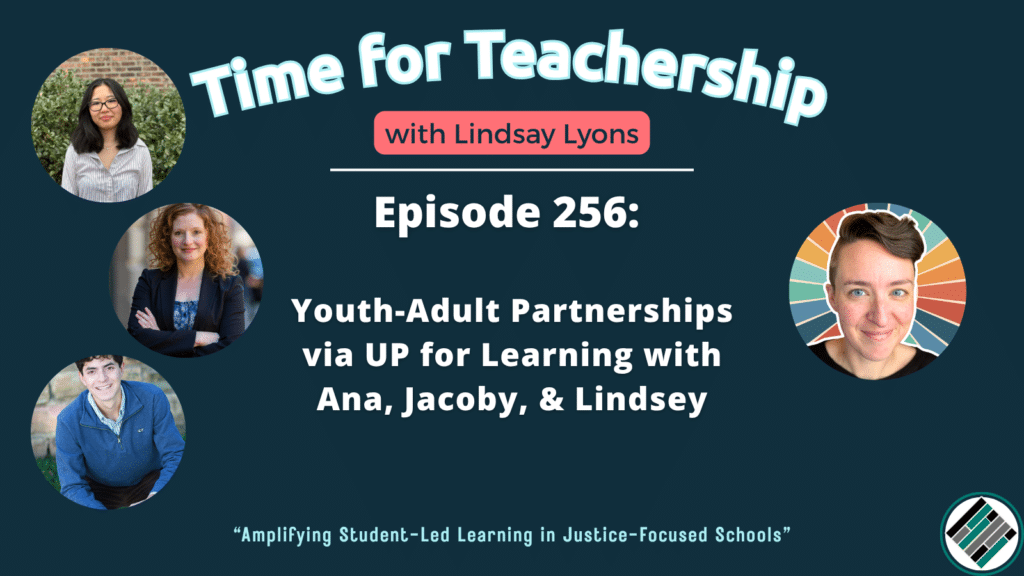
In this episode, we dive into a discussion about youth-adult partnerships with guests Lindsey Halman, Jacoby Soter, and Ana Lindert-Boyes from UP for Learning, an organization committed to reimagining and transforming education through youth-adult partnerships.
Our conversation highlights the immense potential of redefining educational spaces through shared leadership between youth and adults. The guests discuss the importance of valuing youth voice, fostering systemic changes in education, and embracing non-traditional learning methods to create environments where all participants can contribute and thrive.
The Big Dream
The vision shared by the UP for Learning team is an education system where equity is not a mere privilege but a fundamental human right. At its core, the dream is to create environments within schools where both students and educators are seen as partners in learning. This involves breaking down existing structural barriers that have been deeply embedded over centuries and fostering practices where every participant’s unique background is leveraged as a source of strength.
Mindset Shifts Required
A significant theme in the conversation is the necessity for adults to cultivate a mindset that views youth as capable partners rather than passive recipients of instruction. This includes recognizing students as valuable contributors and reframing their roles to empower them in decision-making processes.
Ana, Jacoby, and Lindsey each emphasize the need to embrace discomfort and openness to new ideas, dismantling entrenched educational structures, and adopting project-based and personalized learning approaches.
Action Steps
For educators, leaders, and other adults seeking to strengthen youth-adult partnerships in a meaningful way, our guests suggest the following action steps:
Step 1: Initiate personal reflection on how educators perceive students. Start by considering students as holistic individuals with valuable insights to offer beyond traditional academic metrics. The mindset shifts that see youth voices as necessary in this partnership is the key piece to any future work. For educators and adults, this is the key place to start.
Step 2: Make use of practical tools like “64 Ways to Strengthen Youth Voice” to find small yet impactful actions educators and community members can adopt to infuse youth-adult partnership principles into everyday practice.
Step 3: Implement tangible activities, such as classroom circle discussions, to foster reflection and empower students. By redesigning classroom settings to include collaborative discussions, educators can practice and facilitate the integration of youth voices.
Challenges?
The resistance to building youth-adult partnership often stems from long-standing educational models. Many educators and leaders may find it difficult to relinquish conventional roles and embrace new ways of interacting that center equity and shared leadership. This shift demands patience, persistence, and a willingness to be uncomfortable but are crucial for systemic transformation.
Stay Connected
You can learn more about the organization on the UP for Learning website or Instagram. Keep in touch with Jacoby via email at [email protected] or on LinkedIn; and Ana at [email protected] or on LinkedIn
To help you implement today’s takeaways, our guest is sharing The P.O.W.E.R. Framework and LETS ACT Framework with you for free. And, if you’re looking for more details on the ideas in this blog post, listen to episode 256 of the Time for Teachership podcast. If you’re unable to listen or you prefer to read the full episode, you can find the transcript below.
Quotes:
- 4:55 “One of our core values is that we view educational equity as not just a privilege, but as a human right.” (Jacoby)
- 8:40 “ These dreams that we have about centering equity and justice in our educational systems can be a reality if we have that high level of leadership and vision to do that, and if we have educators who feel empowered to be able to change a system that has operated in a particular way for 150 years plus. And, when there’s that support from the community.” (Lindsey)
- 15:03 “The most basic level of youth-adult partnerships … is that adults need to view youth voices as valuable and necessary.” (Ana)
